ACL VC Dual Amp
ACL VC Dual Amp
In stock
Description / Specs
Description / Specs
VC Dual Amp is not just a VCA, it’s two great VCAs. Amplify signals with unrivaled, oscilloscope-grade accuracy, free from coloration, distortion, and bleed. Meanwhile, the DC-coupled signal path allows CV-scaling while the dual topology enables creative crossfading and more.
There’s an old saying in modular circles: you can’t have too many VCAs. But we think it should say ‘you can’t have too many great VCAs’. And that’s what we set out to make – two great VCAs, in one!
Dual VCA delivers unrivaled clarity of sound, amplifying an input signal insanely accurately, without any coloration, distortion, or bleed.
But before we explain why, let’s be completely clear: we know VCAs are one of the least exciting elements in a modular system (although slightly more interesting than power supplies and busboards, perhaps). Still, they are essential and have a dramatic sound-shaping role.
And there’s always room for some new ideas, as we’ve set out to show.
Classy form
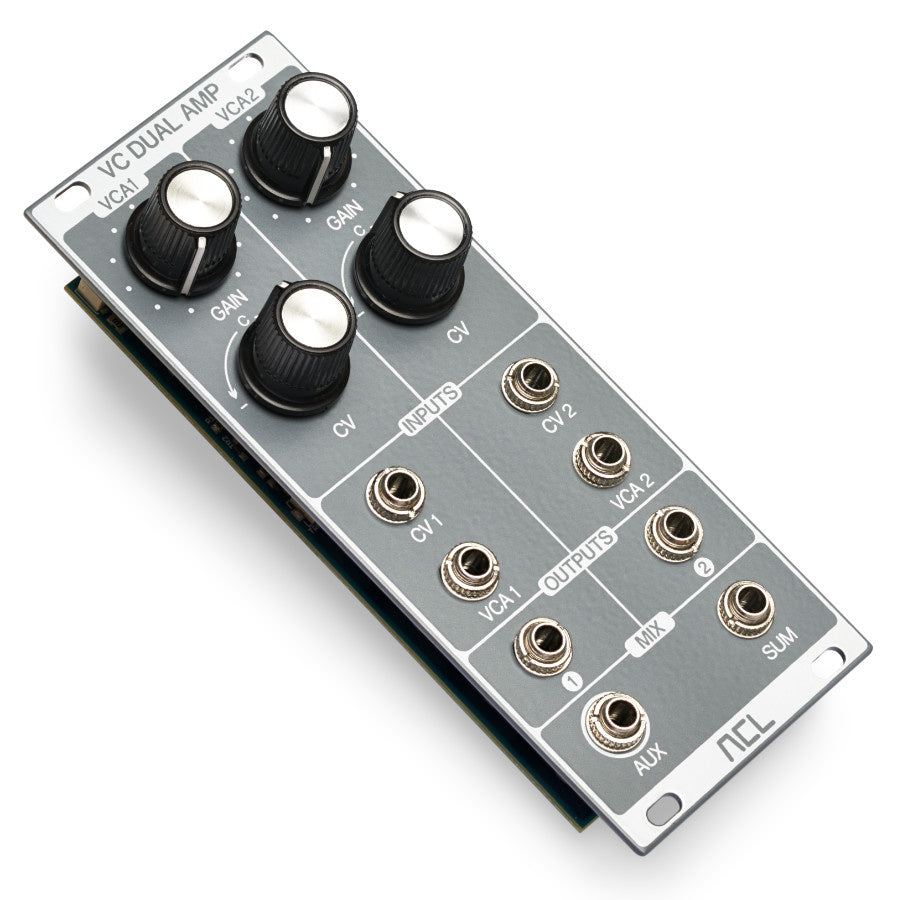
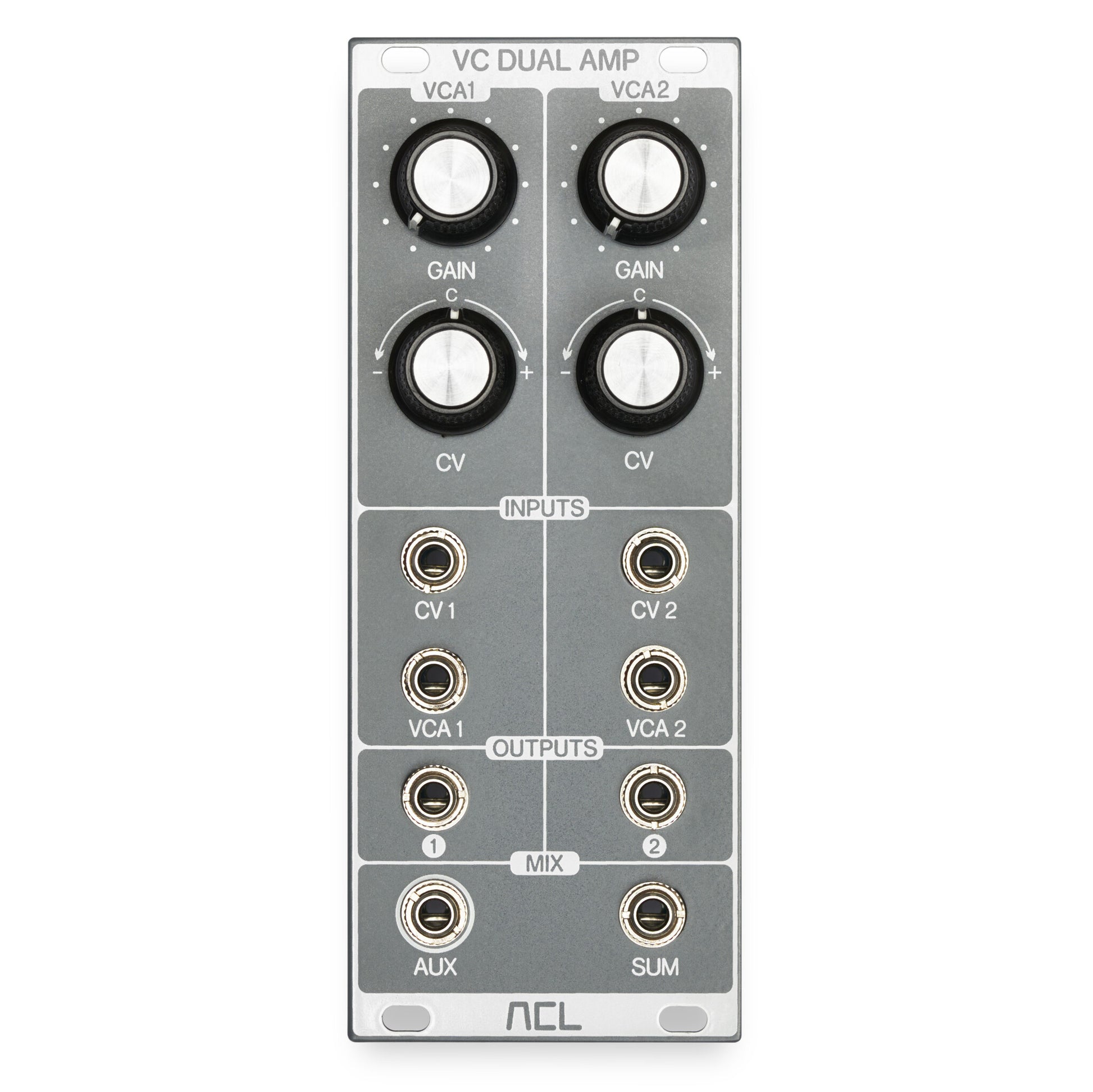
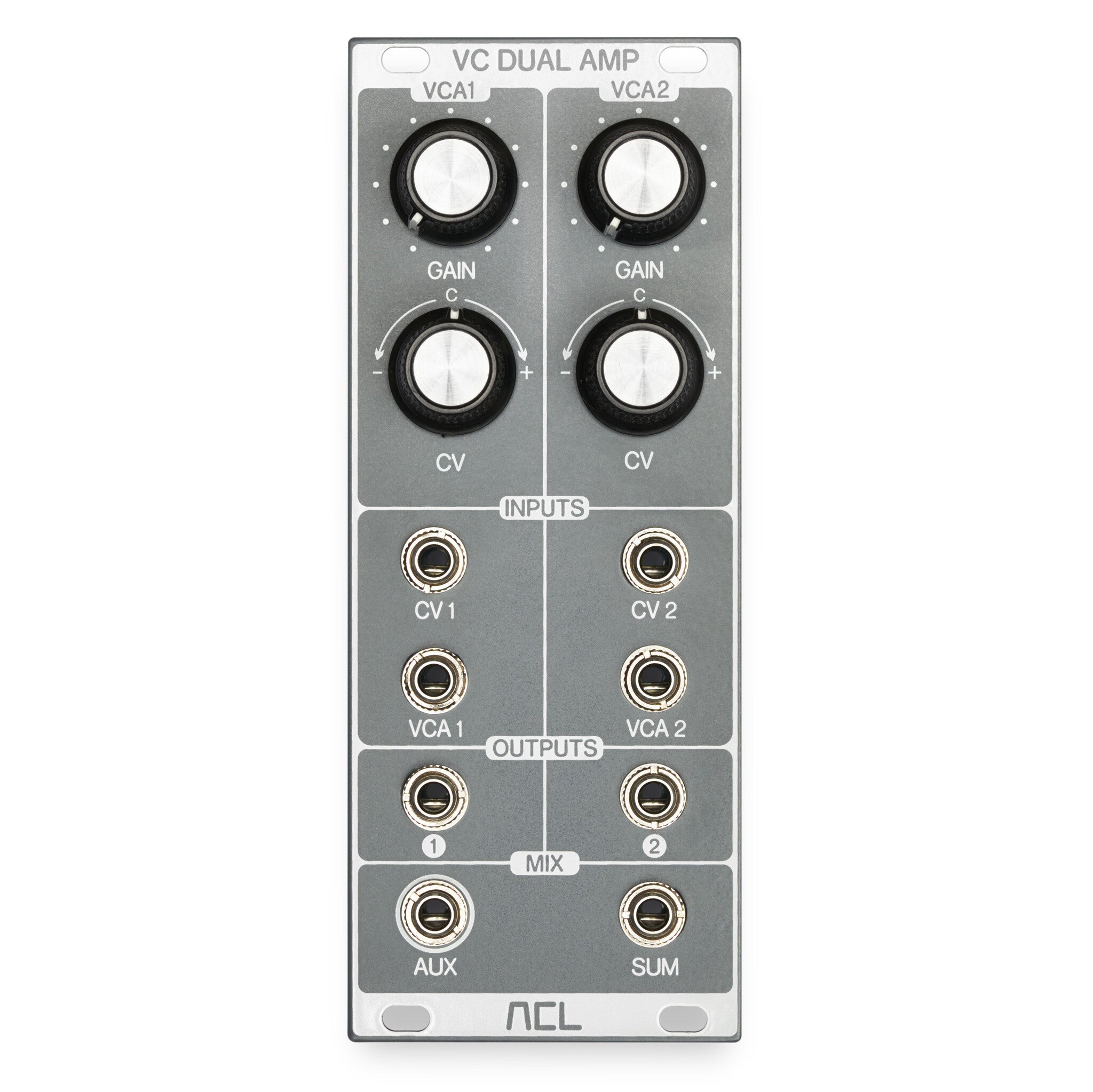
At a glance, things still look pretty simple – four knobs, five inputs, and three outputs – but below the surface is what we believe to be a completely new approach. Let’s take a closer look…
The ACL VC Dual Amp module comprises two identical fully discrete linear VCAs. The VCA design is an entirely new circuit, unlike any we have encountered before, based on the kind of circuits found in highly precise measurement devices like oscilloscopes, then adapted to allow gain change with external CV.
A VCA with benefits
And we didn’t just go to all this trouble to be different! Our design offers significant performance advantages:
- very low THD (throughout the entire linear gain range)
- lower noise than conventional designs
- no crossover distortion (thanks to a class-A operating mode)
- no overshoots or ringing (because we avoid global feedback for operating point stabilization and linearization, using local feedback instead)
- very low CV feedthrough (due to excellent common-mode rejection)
- no audio feedthrough from the Input to the Output
- very high dynamic range, offering plenty of headroom
- extremely high bandwidth (0 Hz to 20+ kHz, with no amplitude drops, phase shifts, or filtering)
- completely DC-coupled signal path (consequently there’s no high-pass filtering of low frequencies and the unit can also be used for CV voltages).
Elegant form
Layout-wise, VC Dual Amp has matching controls for both VCAs: a manual control knob for gain and an attenuator control for scaling the CV input.
The audio and CV inputs of VCA 1 are normalized to VCA 2. In other words, if nothing is plugged into Audio 2/CV 2, then the signals from VCA 1 will be recreated there. This is very handy for creating voltage-controlled crossfade effects, voltage-controlled stereo panning tricks, and other similar processes for which one or both VCA 1 and VCA 2 use the same signal.
VC Dual Amp also features a completely DC-coupled signal path, which means it can also process control voltages via the audio input, further expanding the creative possibilities. For example, it could be used to modulate the depth of another modulation, such as velocity-modulated amplitude or the LFO modulation depth of a VCO pitch.
Finally, in addition to the individual outputs for each VCA, there is a Sum output combining the signals of both, plus the signal from an Aux input, allowing three different signals to be mixed together. And, of course, these can be audio or CV/control signals.
Smart is sexy
Okay, so we’ve already admitted that no VCA is pin-up sexy, but by now we like to think you’ll agree that this is the kind of VCA that is attractive, fun, and interesting enough to have a long and meaningful relationship with. And at some stage, we’ll all be glad to have some of that in our lives.
3U Eurorack module, 10 HP wide, compatible with Skiff cases
Current Draw:
- 34 mA +12V
- 29 mA -12V
- 0 mA 5V
Installation depth:
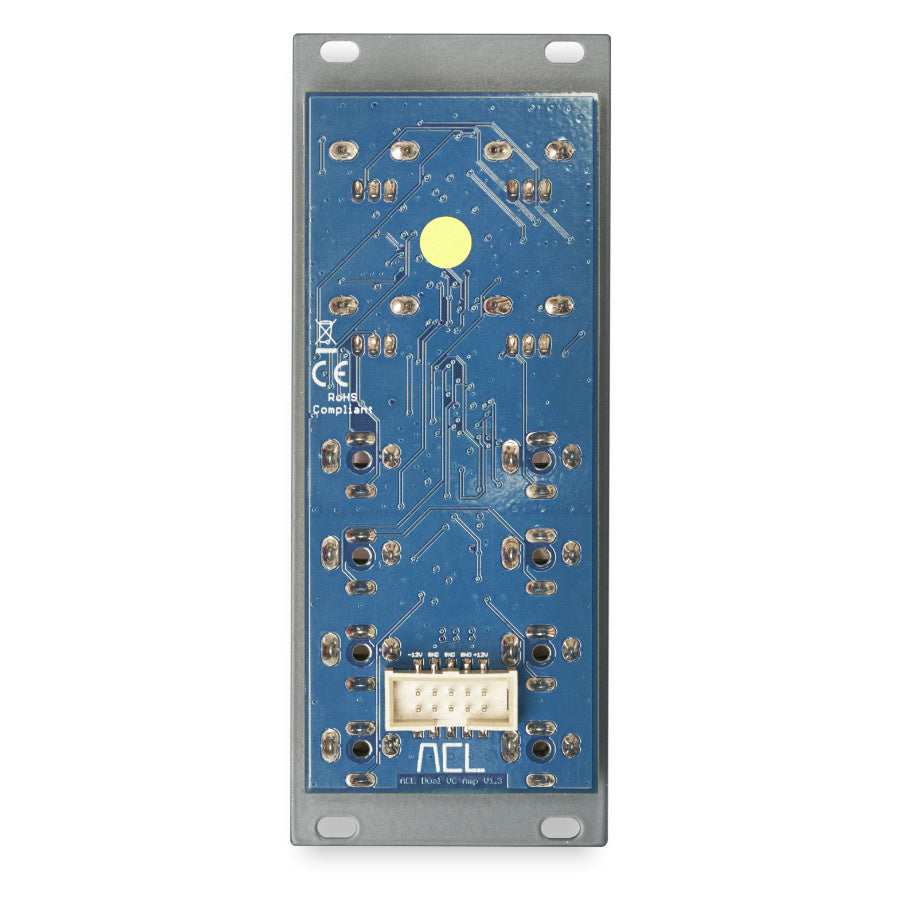
- 22 mm deep